 :
:  :
: 


 CUBICLES CODERS PVT LTD
Why Your AI Implementation Needs a Legal Audit Before Launch
Why Your AI Implementation Needs a Legal Audit Before it Goes Live: Safeguarding Innovation and Compliance

Estimated reading time: 10 minutes
Key Takeaways

- A comprehensive legal audit is crucial for AI solutions to avoid potential fines and legal issues.
- AI technologies raise unique challenges in compliance, privacy, and bias that standard reviews may overlook.
- Emerging laws like the EU AI Act will enforce strict regulations that require transparency and risk assessments.
- Real-world case studies demonstrate how legal audits prevent mishaps before implementation.
- Conducting these audits enhances brand trust and solidifies a competitive edge in the rapidly evolving AI landscape.
Table of Contents

- Introduction
- The Rising Need for Legal Audits: Problem and Trends
- How a Legal Audit Ensures AI Compliance and Risk Management
- Real Examples: How Legal Audits Prevented AI Mishaps
- Step-by-Step Guide to Conducting an AI Legal Audit
- Benefits and Tips for a Successful AI Legal Audit
- Future Trends in AI Legal Auditing
- Conclusion
- FAQ
Introduction
Artificial intelligence (AI) is transforming industries globally—from healthcare and finance to retail and manufacturing. In India and worldwide, organizations are racing to harness AI’s potential to improve efficiency, customer experience, and competitive edge. However, why your AI implementation needs a legal audit before it goes live is a question worth serious attention. With AI technology evolving rapidly, so are laws and regulatory frameworks aiming to govern its ethical and lawful use.
Skimping on a legal audit before launching AI solutions can expose companies to steep fines, lawsuits, and lasting reputational harm. Moreover, AI presents unique challenges in data privacy, bias, intellectual property, and transparency that traditional legal reviews might miss. This article dives deep into why a dedicated legal audit is an indispensable step before your AI system touches the market, especially under stringent frameworks like the EU AI Act and India’s upcoming digital laws.
We will explore how legal audits prevent costly mistakes, case studies highlighting risks, practical steps for conducting audits, and emerging trends impacting AI legality worldwide. Whether you’re a startup or an enterprise, understanding these facets is essential to build AI you can trust—both legally and ethically.
The Rising Need for Legal Audits: Problem and Trends
AI adoption is soaring—with global AI market revenues projected to reach over $500 billion by 2024. But this growth fuels regulatory scrutiny. According to a 2023 report by Gartner, 80% of AI-related failures are linked to non-compliance or ethical oversights. Data shows:
- The European Union’s AI Act will require transparency and risk assessments for high-stakes AI applications.
- India is drafting AI policies emphasizing fairness, privacy, and accountability.
- Data breaches involving AI datasets rose 30% over two years, leading to substantial penalties.
- Legal challenges citing AI bias and discrimination have surged across sectors like recruitment, credit scoring, and healthcare.
Ignoring legal audits exposes businesses to:
- Heavy fines under GDPR, CCPA, and other data laws.
- Lawsuits due to algorithmic bias or IP infringement.
- Loss of customer trust impacting brand value.
- Unclear liability in AI-driven decisions.
A comprehensive legal audit mitigates these risks by systematically identifying compliance gaps and ethical issues early in the AI lifecycle.
How a Legal Audit Ensures AI Compliance and Risk Management
Legal audits go beyond generic regulatory checklists. They involve specialized review processes covering multiple dimensions, including:
1. Compliance with Evolving Regulations
Auditors verify adherence to jurisdictional laws like GDPR, the EU AI Act, India’s Personal Data Protection Bill, HIPAA (healthcare), and industry-specific rules.
2. Data Privacy and Security
The audit examines data sourcing, consent mechanisms, data minimization principles, encryption standards, and third-party data sharing agreements.
3. Bias and Discrimination Checks
Using technical and legal analysis, auditors identify potential AI biases in training data and outcome patterns and recommend mitigation strategies.
4. Intellectual Property Rights
Ensuring all algorithms, training data, and AI-generated outputs have licensing confirmation and that no third-party IP rights are compromised.
5. Transparency and Explainability
Assessing whether AI decisions are auditable and explainable to compliance authorities and end-users, fulfilling ‘right to explanation’ mandates.
6. Contract and Liability Assessment
Reviewing contracts with vendors, clients, and partners to clearly delineate AI-related liabilities and responsibilities.
7. Ethical and Corporate Responsibility Review
Aligning AI applications with company values and emerging AI ethics frameworks, building social trust.
| Legal Audit Dimension | What It Includes | Why It Matters |
|---|---|---|
| Regulatory Compliance | Checking conformity with AI/Privacy laws | Avoid fines and sanctions |
| Data Privacy & Security | Data collection and protection measures | Prevent data breaches and liabilities |
| Bias & Discrimination | Analysis and mitigation of algorithmic bias | Reduce discrimination claims |
| Intellectual Property (IP) | IP rights validation and licensing checks | Prevent costly IP disputes |
| Transparency & Explainability | AI decision auditability | Build user trust and comply with laws |
| Contractual and Liability | Review of vendor/partner contracts | Manage risk exposure |
| Ethics & CSR | Ethical impact evaluation | Ensure societal trust and brand integrity |
Real Examples: How Legal Audits Prevented AI Mishaps
1. Recruitment AI Tool – A Global Tech Firm
The company planned to deploy AI-driven candidate screening but found racial bias during the legal audit. It led to redesigning algorithms with diverse training data before implementation, avoiding potential lawsuits and bad press.
2. Healthcare AI – Indian Hospital Chain
After a legal audit, the hospital strengthened patient consent forms and data encryption to comply with both Indian and EU data protection laws, preventing penalties following a minor breach incident.
3. Financial Services Chatbot – Multinational Bank
A legal review revealed that third-party data providers lacked adequate licensing for training data. The bank renegotiated contracts, safeguarding IP rights and evading costly infringement claims.
4. Autonomous Vehicles AI – Automotive Manufacturer
Audit highlighted lack of transparency in decision-making algorithms. The company introduced explainability features, helping it align with upcoming AI regulations and strengthen consumer trust.
5. Retail Recommendation Engine – E-Commerce Platform
Legal team flagged privacy concerns related to data sharing with marketing partners. Modifications based on the audit ensured compliance with multiple data protection laws across global markets.
These examples show that a legal audit acts as an early warning system, enabling organizations to correct course before public launch.
Step-by-Step Guide to Conducting an AI Legal Audit
Conducting a legal audit for AI implementation can be straightforward when broken into manageable steps:
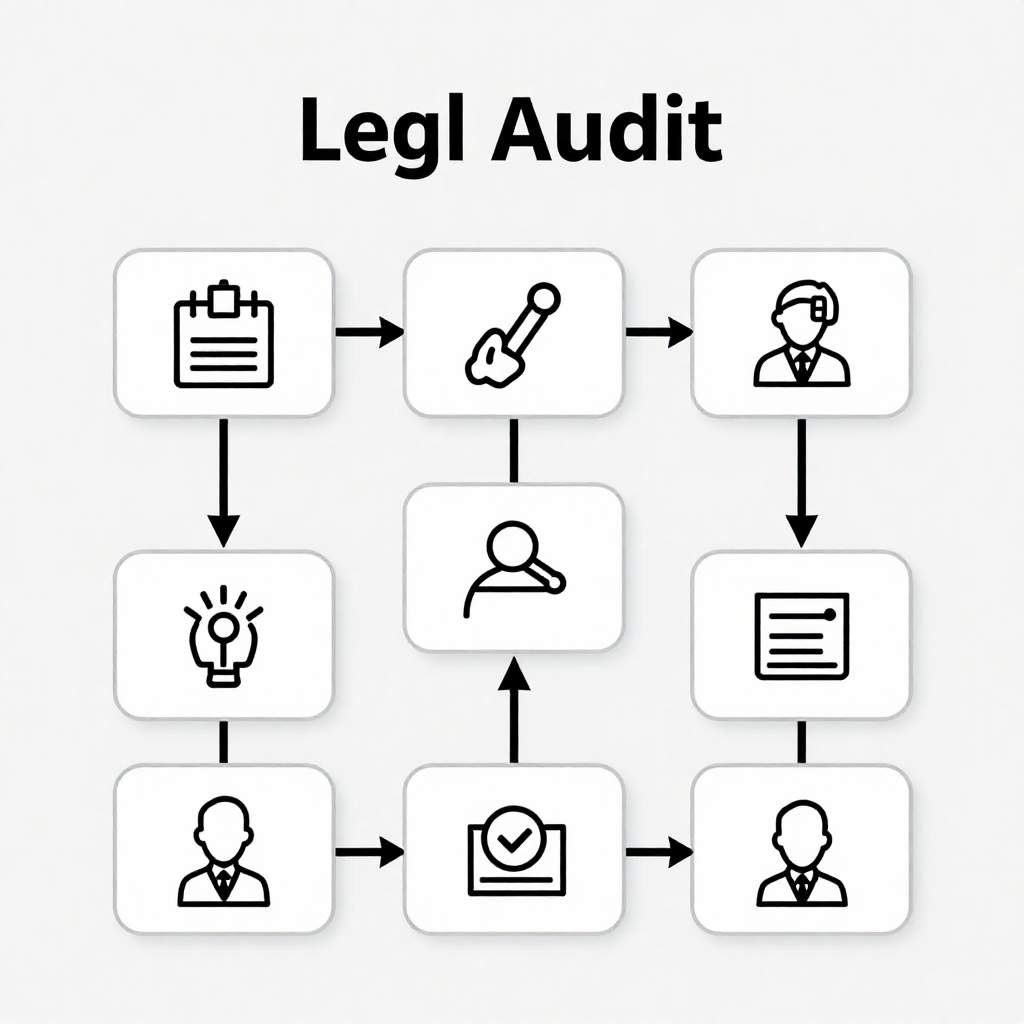
- Define Scope and Objectives
Identify AI components, data sets, deployment environments, and regulatory jurisdictions involved. - Assemble a Multidisciplinary Team
Include legal experts, data scientists, UX designers, and compliance officers. - Map Data Flows and Sources
Document where and how data is collected, stored, processed, and shared. - Review Regulatory Requirements
Analyze applicable laws such as GDPR, CCPA, AI Act, and sector-specific rules. - Conduct Bias and Fairness Testing
Use tools to scan for discrimination or ethical concerns in datasets and algorithms. - Evaluate Intellectual Property Rights
Verify licenses and ownership for all AI assets and third-party inputs. - Assess Transparency and Explainability Measures
Confirm that AI decision-making processes can be explained to users and regulators. - Check Contractual Agreements and Liability Clauses
Ensure clear definitions of responsibilities regarding AI performance and errors. - Document Findings and Remediation Plans
Create a comprehensive report outlining risks and recommended actions. - Re-Audit Post-Implementation
Regular audits post-launch to sustain compliance and address emerging risks.
Following these steps creates a repeatable framework that can adapt as regulations evolve.
Benefits and Tips for a Successful AI Legal Audit
Benefits:
- Regulatory Security: Minimize risk of fines and regulatory interventions.
- Brand Trust: Enhance customer confidence through transparent and fair AI use.
- Risk Mitigation: Identify and address ethical, legal, and operational risks early.
- Competitive Advantage: Gain better market acceptance with lawful technology.
- Clear Accountability: Define liability in contracts to protect your organization.
Tips:
- Start audits early in the AI development cycle, not last minute.
- Use AI auditing tools alongside human expertise.
- Keep abreast of evolving AI laws globally to ensure multi-jurisdictional compliance.
- Incorporate feedback from diverse stakeholders to improve fairness.
- Maintain documentation for legal defense and continuous improvement.
Future Trends in AI Legal Auditing
As AI regulations mature, legal audits will become more sophisticated with automation and standardized frameworks. Emerging trends include:
- AI-Specific Compliance Certifications: Third-party seals verifying ethical AI.
- Continuous Real-Time Auditing: Using monitoring tools to flag risks post-launch.
- Global Regulatory Harmonization: Streamlining AI laws across borders to ease compliance.
- Integration of Ethical AI Metrics: Embedding corporate conscience into audits.
- Use of Explainable AI (XAI) Technology: Making transparency the norm.
Staying ahead of these trends will ensure your AI implementation remains compliant and trusted in a changing global environment.
Conclusion
Why your AI implementation needs a legal audit before it goes live is no longer optional—it’s a critical safeguard in today’s AI-driven world. Legal audits protect your organization from costly penalties, reputational risk, and ethical pitfalls by ensuring compliance, fairness, transparency, and accountability. From startups to global enterprises, incorporating comprehensive legal reviews strengthens your AI’s reliability and market acceptance.
Don’t wait for problems to surface post-launch—contact us today to learn how to conduct an effective AI legal audit tailored to your needs. Secure your AI innovation with confidence now.
FAQ
Q1: What is a legal audit in the context of AI?
A legal audit for AI is a systematic review of your AI systems to ensure compliance with laws, ethical guidelines, and contractual obligations before deployment.
Q2: How often should an AI legal audit be conducted?
Ideally, audits should be done before launch and periodically after deployment to monitor compliance with new regulations and emerging risks.
Q3: Does a legal audit cover ethical concerns?
Yes, modern AI legal audits include examining ethical issues such as bias, discrimination, and corporate social responsibility.
Q4: Can small businesses afford AI legal audits?
Yes. Tailored audits scaled to your AI’s complexity are available to suit organizations of all sizes and budgets.
Q5: What consequences can arise from skipping the legal audit?
Skipping the audit can lead to fines, lawsuits, damage to reputation, loss of consumer trust, and operational disruptions.
[Related post: How to Build Ethical AI Systems – Best Practices and Frameworks]
[Related post: Top AI Compliance Tools for 2024]
—
Recent Blog

Is Your Website Ready for 6G and Spatial Web?
Is Your Website 6G Ready? The Shift Toward Spatial Interfaces…

AI Voice Agents Boost Real-Time Payment Collections
The Voice of Revenue: How AI Voice Agents are Revolutionizing…

WhatsApp Log-Out Disruption: What Business Owners Must Know
Business Owners and Dropshippers: Coping with the WhatsApp "Log-Out" Disruption…
